English (UK)
  Nederlands
I am bullied at work
What can I do?
- Tips for people being bullied at work.
- Tips for bystanders who want to help someone being bullied.
Take your feelings ('I am being bullied at work') seriously. Bullying is harmful and not just to you; it is a group event. Bullying also affects the working atmosphere of others, damaging the flexibility of the whole department and thus damaging the organisation. You feel victimised, but you are not alone in this. Read here How we look at a bullying group.
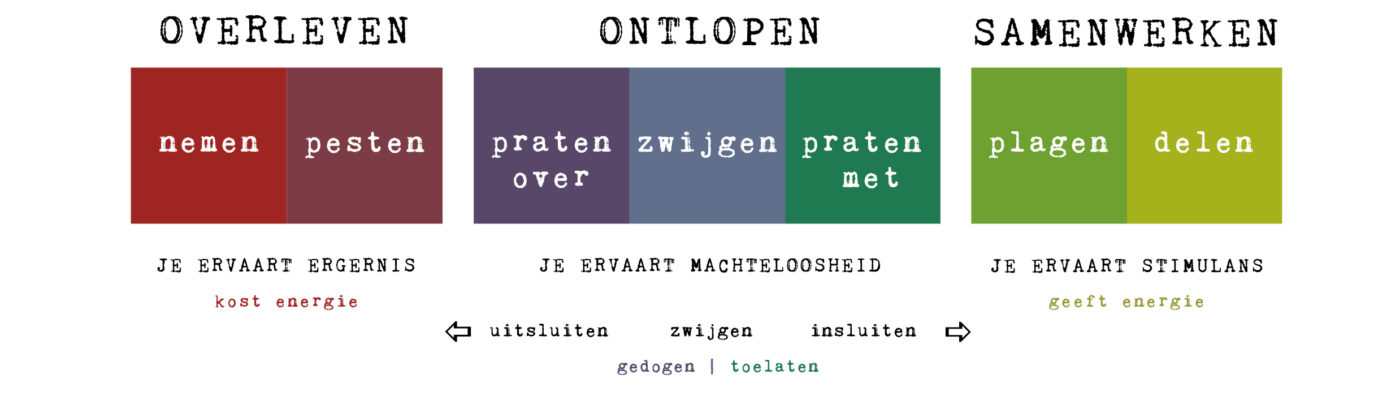
Normally, bullying behaviour is noticed and corrected by group members, managers and other bystanders. After all, respectful teamwork is an important prerequisite for business success. But under pressure, team members may start to behave in a 'strugglingist' or 'avoidant' manner. No one behaves more relaxed and free, teasing becomes bullying. Everyone's job satisfaction disappears.
In a bullying environment, humour is perceived as mean. Reacting spontaneously to a joke then no longer works. You don't want to pay with even money either, which makes responding complex.
Getting help is important. Important for you, but also important for the team and the organisation. While it may be hard for you to see, you are helping the organisation by getting moving.
By including a positive alternative alongside your complaint ('I'm being fitted at work') in your call for help ('I want to help improve the atmosphere at work'), you make it easier for bystanders to catch on. Just one person in your group willing to support you can make a difference. This website gives you a overview of opportunities should it be possible to enlist the help of external team coaching.
These are some of the options. The most effective one is at the top:
Formulate what you expect from the other person and what constitutes respectful action for you. If you have an (influential) colleague who is willing to help you with this, you will be in a stronger position. Read together these web pages where different possibilities are listed.
We advise you not only to focus on the negative behaviour, but also to think about what will benefit the whole team: a better working atmosphere. You then also formulate a goal instead of just the problem. This makes it easier for people to get involved. If you have an (influential) colleague who wants to help you do this, you will be in a stronger position.
We distinguish between bullying and teasing. It is recommended to our view About a group that is being bullied read first.
Bullying is a group activity, harmful to everything and everyone and requires correction.
In our approach, we approach not so much the actors but the group as a whole. Below is a list of possibilities. See where you can hook in. Point 1 delivers the most, the last point the least.
You strike a positive note, share with your team where you want to go and indirectly bring up the undesirable behaviour. In conversation and with a positive goal in mind, this is easier. This website can help you do that on your own. You can also consider working with team training or team coaching accelerate the process of improvement.
Set a positive goal you want to move towards together. This will make it easier to transform serious behaviour into a new shared cooperative culture. In contact with people outside the team, it is important that you behaviour brings up. It is not as effective to 'play at the man'. That increases pressure, while you want to reduce it.
Again, formulating what is positively needed is a better approach than focusing on the problem. Give the body some time to take action and possibly refer to this website for support options. Persevere and possibly move up a step in the organisation if there is no improvement.
Bullying behaviour has many causes. It can be persistent, carried by managers or even actively supported. Bullying at work is absolutely undesirable and harmful. Taking action is therefore the only option.
Contact