English (UK)
  Nederlands
 Feedback training courses
Our feedback training courses address complex work situations. Although giving and receiving feedback seems simple, practice shows that during a training course, teams soon start talking about what works and what does not work in their own situation. Everyone knows that a strong team dares to address each other - in a way that connects rather than removes. Yet in many teams, feedback gets stuck in subtle hints or is mistaken for criticism, resulting in tensions that no one really gets on with.
Our feedback trainings help teams to see and use feedback for what it is intended: learning from each other, creating clarity and purposeful collaboration from trust. With practical exercises and the Collaboration Scale, we make the difference between criticism, a hint and valuable feedback concrete in feedback training. In this way, a culture grows in which calling each other to account becomes normal. In which mistakes and successes are shared and lead to development and job satisfaction.
A feedback training course is a perfect follow-up to a day(s) teambuilding and communication training with communication styles.
- Relaxed attractive interactive feedback training sessions
- Experienced team coaches with backgrounds in healthcare, education, government and business
- Indoor, outdoor or in-company - fully customised in each feedback training course
- Especially suitable for teams facing this issue.

Which feedback training courses suit your team?
Workshop | Clinic | Training | Masterclass > choose the feedback training that fits

 4 hours
 Intro
Intro
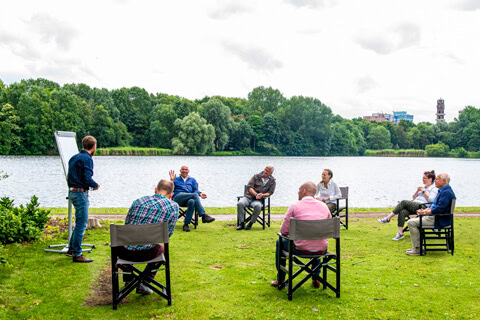
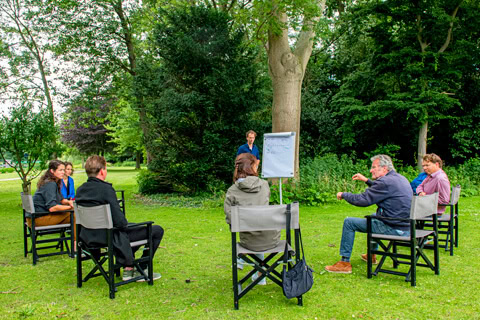

Criticism, a hint or feedback?
In all feedback training, we distinguish between criticism, a hint and feedback.
This distinction provides insight and makes a difference.
Criticism
Sometimes feedback is received as criticism. Those who get irritated, wait too long or are caught off guard give feedback in an emphatic way that makes it harder for the other person to receive it with a learning attitude. Some are more sensitive to this than others. This emphatic way of addressing each other (with irritation) then contributes to taking the feedback personally. Everyone understands the difference between drawing attention to a task or playing it on the person. You will learn more about this in feedback training. How someone can receive feedback properly is best discussed with each other, for instance in the feedback training.
Hints
In addition, much feedback is not feedback at all but a non-committal hint. We call feedback a hint as soon as no agreements about who will do what follow. By keeping it 'vague', no one is addressed and everyone thereby preserves their own space. "We need to work better together!". But without addressing Henk that he should be present at the monthly meeting for this, Henk remains ignorant and as long as no one gives direction, we call it a hint.
Everyone agrees that better cooperation is desirable, but no one shares what the trigger is, what the task is, or what is bothering them.
There is another form of hinting that is common: not wanting or not being able to choose. An additional investigation may then be one of the outcomes, but no concrete choice is made. This then easily leads to (temporary) stagnation, from which irritation can easily arise. A group of angry colleagues as a result.
Feedback
For us, feedback is only feedback when it is clear where a team (an organisation) wants to go together and where employees also grant each other something. As soon as someone gives feedback from an attitude of benevolence and with a clear shared goal, the other person can receive it in a learning manner and in this way you also learn together from mistakes made. "How nice of you to say it, I can do something with this!" We use The Scale of Cooperation.
Feedback or Feedforward?
In our field, there is debate about whether feedback is not better called feedforward.
Some colleagues opt for feedforward.
Feedforward is forward-looking in their eyes and in that future you can change something.
Feedback would focus too much on looking back,
with which one evokes (in the other) mainly annoyance.
Feedback thus takes on a negative colour.
How does it work?
- 1. Intake: we explore the questions, goals and current feedback culture in the team
- 2. Tailor-made proposal: with feedback training, location and method
- 3. Implementation: experiential feedback training with reflection
- 4. Feedback: insights and follow-up actions for the workplace
Our feedback trainings are not a theoretical lecture, but an experiential approach in which doing, experiencing and reflecting are at the core. We work with concrete situations from a team's own practice, so that exercises are immediately recognisable and relevant.
We make the difference between criticism, hints and real feedback tangible in our feedback training and use the Scale of Cooperation to explore how feedback can contribute to growth and connection. In doing so, we create a safe environment where tension can also be discussed without judgement.
The result? Teams that address each other with more confidence, make clear agreements and work together to create a culture of learning and development.
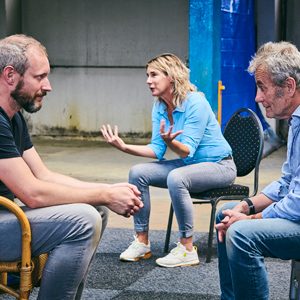
What does Feedback training give a team?
- Greater trust and safety within the team
- Giving and receiving feedback is desired and without tension.
- Clarity in expectations and agreements are thereby increased
- Quicker learning together from mistakes and sharing successes (also to learn from).
- Beyond the irritations and ambiguities.
- A culture where addressing each other is normal and valuable
Feedback can feel tense or vague in teams. It often gets stuck in general comments or is quickly perceived as criticism. In our feedback training we make this concrete and workable. We show how giving and receiving feedback does not have to be fraught, but can actually contribute to growth, clarity and greater job satisfaction.
A person's communication style plays an important role in this. Is one going for thoroughness, the result, innovation or a good working atmosphere? Each goal results in a different communication style, especially when the pressure is on.
Once the 'or' becomes an 'and' a team moves forward.
By practising with recognisable situations in a safe setting, teams discover how to address each other with confidence. Feedback thus becomes a practical tool to learn faster, break patterns and work better together - clear, honest and directly applicable in daily practice.
Frequently asked questions about feedback training sessions
Why choose Team4Teams?
Many providers present feedback as a method or technique to be learned. At Team4Teams, we believe that feedback is not a trick, but a skill with the most important part being someone's attitude: giving each other something and learning together with a clear goal in mind. That is why we do not deploy standard questionnaires or complicated models, but work with what is actually going on in the team.
We use the difference between criticism, hints and real feedback to make colleagues' attitudes concrete. Whereas criticism often feels personal and fraught, an attitude appropriate to feedback actually facilitates collaboration. With experiential exercises and the Scale of Cooperation the team experiences how openness, safety and trust are strengthened.
Results also require duration. With Team4Teams, the team is given the opportunity and time to grow sustainably. The result is not a paper report or a tick 'we have had a course', but concrete action and sustainable change in behaviour and culture: giving and receiving feedback thus becomes ordinary, valuable and instructive.
These are reasons for choosing Team4Teams.
How practical is feedback training from Team4Teams?
Very practical. There are skills and attitudes that one does not learn from a book. Giving and receiving feedback is learned by doing it. In our training sessions, we work with recognisable situations from a team's practice. We organise experiences in which team members give and receive feedback, and immediately notice what it brings to cooperation and does to trust.
In doing so, we make the difference between criticism, hints and real feedback concrete. We practice with conversations that sometimes feel tense or vague and translate this together into clear, workable agreements. In this way, teams not only discover how one gives feedback, but above all how a team improves together. The result: a learning experience that sticks and tools that team members can apply the very next day.
Do you also coach individuals or small groups when it comes to feedback?
We do that, but always in conjunction with the team. After all, feedback is about the relationship and cooperation with each other. If one person receives training without the team taking part, there is a risk that the team will remain aloof or even react dismissively. Then the change will not be supported and the situation will remain unchanged. So we do not believe in courses with individual enrolment. Going out together is much more effective.
Our starting point is therefore: first the team, then possibly individually. The team learns to give and receive feedback together, so that everyone takes responsibility and no one is left alone. Individual coaching can then be supportive, but always in relation to the joint context. This creates sustainable change, which does not stick with one person, but strengthens the whole team.
Sometimes feedback is needed in the vertical line of an organisation. Especially in situations where people are pointing at each other, this is going to help. Ask us about the possibilities.
How do you use the Scale of Collaboration in feedback training?
The Scale of Cooperation we use as a mirror and conversation starter. It gives teams instant (within minutes) insight into where they stand together: at a stage with resistance, distance or commitment. This immediately reveals why cooperation sometimes goes awry and where there are opportunities to grow.
During feedback training, a team discusses concrete team situations on the scale. This makes it clear what is already going well and what still needs attention. A team then works step by step on taking the next step up: from criticism with resistance to feedback in commitment, from vague hints to clear agreements, from tension to trust.
The strength of the scale is that it provides overview and language. It makes differences discussable without judging and gives teams practical tools to take responsibility for their own development. In this way, not only insight, but especially cooperation grows in daily practice.
My team has resistance to feedback training, what is the advice?
In our experience, actually every team looks up to feedback training.
There are several ways to lower resistances and also turn them into curious participation:
- In case there are resistances in the team itself between colleagues, it is recommended to start with individual introductory talks. We then create the feedback programme together afterwards.
- In case there is group formation and, for example, management is 'to blame for everything', a team day for these two groups together is the best choice. Then choose team building with reflection. Take your time, because new trust is built step by step.
- The best choice is not to start with a feedback training, but to opt for a day of team building with reflection. Because with this team programme, the whole day is about nothing more than 'how does a team achieve pleasant, light-hearted, concrete, effective feedback'. The context of team assignments makes it seem like it is not about work, while everyone will realise as the day progresses; this is no different at work. The day is playful and challenging in design, and the extent to which feedback is addressed as a theme is discussed by the clients in advance with the team coach(s).
There is a lot to do around feedback. Feedback training is the best choice if the team itself asks for it and is curious about it. If they disagree or intend to offer the training as a surprise, the effect also drops. Feedback is not a one-way street but a skill between colleagues who look forward to it. So this also requires a culture of not surprising or obliging each other.
At Team4Teams, feedback training sessions are a concluding day after a process, in which getting to know each other better with team building, learning to understand and appreciate each other's communication styles with communication styles is ultimately secured with feedback training.