English (UK)
  Nederlands
How does a bullying
group out
- Learning to recognise a bullying group
- Tools to adjust
- No blame approach
What does a bullying group look like? The question requires detailed explanation. There are scientific studies published about it, in addition, it can also be summarised as follows:
There are teasing and bullying teams. Teasing and bullying are group activities. Teasing is spontaneous behaviour, goes back and forth, is sometimes not fun, but has a social learning effect. Bullying is different. In bullying behaviour, a group targets one person for an extended period of time. There is no escape for the bullied person. Bullying is harmful and also occurs regularly in adult teams.
Team4Teams joins a 'no blame' approach in which tackling bullying is based on the idea that it's the team's turn to regain job satisfaction is launched.
Bullying in the workplace is a taboo subject. Things get locked down. That alone is hugely damaging to an organisation. But once it takes place, there is much to gain.

A bullying group need not inevitably be a final outcome; nor does it have to remain a taboo subject, but can act as an impetus to take action.
And yet,
in all situations, someone is needed who will have to take up the gauntlet with a positive goal in mind, better results and a positive connection:
with team development (and attention to organisational culture),
usually picked up by a director, CEO, or initiated by the SB, and/or hrm.
with team training (focusing on skills),
usually picked up by a management team, team manager or initiated by a trustee and hrm.
with teambuilding (not too heavy, with a growth-oriented approach)
usually picked up by a team leader or initiated by team members or hrm.
A works council, co-determination council, or in the care and education sector a client or parents' council also sometimes occupies a key position.
Putting the team first and focusing on positive team growth and better results.
Below, we approach the taboo by focusing on the structure of a bullying group, always with prospects of an approach.
In a team under pressure, a hierarchical order emerges. Power differentials emerge.
Once this creates a negative mindset and the problems get bigger, common goals fall out of the picture. People come to oppose each other. Then, if no correction takes place, the team is likely to assign blame. Someone is blamed for the pain everyone feels. People start 'playing the man'.
What follows is a surviving power play with, in the end, purely losers. In a so called bullying group, this general negative process - where power and influence are at stake - has resulted in 'winners' and (future) losers.
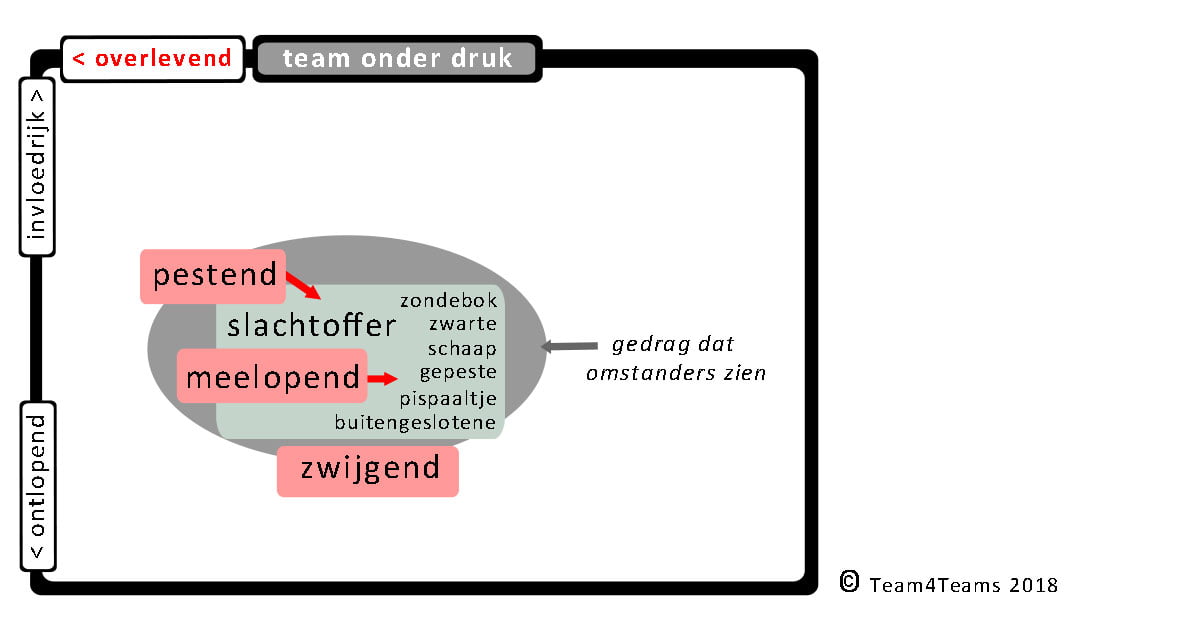
If you ask bystanders what they see, they usually mention three roles: the bully, the followers and the victim (the scapegoat, the bullied). Sometimes they also see the team members watching silently. If one later asks the victim which of these three roles was the worst, it is often that of the silent ones: 'I had nowhere to go, everyone was laughing at me, I felt completely isolated'.
Click image to enlarge...
Team4Teams' team coaches use a 'no blame approach'. The first thinking step in this is that people are OK, but sometimes behaviour is not. So we do not talk about a 'bully', but about 'bullying behaviour'. Actively supporting respectful behaviour is central. The focus is shifted from looking back ('Who is guilty here?') to looking forward ('What behaviour do you desire?'). The central question is how behaviour (that was once positive) can become positive again.
Sometimes a period of cooling down is needed, where people no longer feed the antagonisms. Sometimes so much resistance has developed for each other (the working relationship is 'broken') that team members first need to build new trust. Naming undesirable behaviour, and asking for positive behaviour, becomes possible once everyone is respected as a team member and valuable employee.
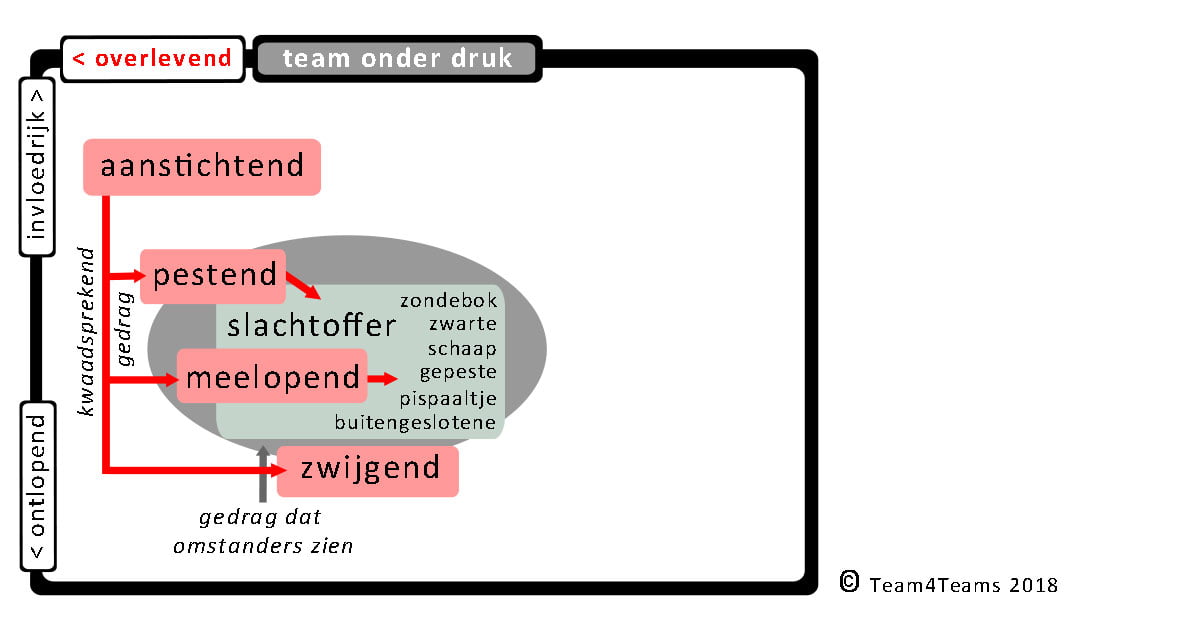
Behind the active disrespectful behaviour is vote buying. Getting a picture of who is guilty of this is essential. Evil speaking, intrigue, instigation: it puts pressure on everyone. The victim often has no idea how and by whom the group is pressurised to act so negatively.
Outwardly reporting what is happening ('snitching', ringing bells) will damage someone's position in the team. Because everyone gets involved in this negative group process and no one wants to be a victim themselves, it is increasingly difficult to break the spell. In the long run, no one believes it can be done at all. Absenteeism, burnout, suicide: the process can fester with which it also becomes visible outside the team. And everyone knows it: this team is no longer functioning... Harmful for everyone, not just the victim and hugely damaging for the organisation.
A team with a gruff, demanding chief is in a different situation from a team where reorganisation is imminent. A group in which jealousy plays a role requires a different approach than one in which there is a struggle for power and influence. If there is unhealthy competition between employees (e.g. fighting for bonuses), this requires a different approach than a team in which there is a cultural difference, racism, or sexual harassment.
A team coach looks for the 'pin' that is piercing the soul of the team and causing the pain. That 'pin' has to come out.
There are also positive openings in a team with bullying. Team members who show courage and dare to be vulnerable can transform a group from a survivor setting to a healthy, collaborative situation. In natural leadership, good contact with each team member is important. Identifying what the deficits are and what is needed to reduce pressure is a key focus and can thus become a positive opening.
In a team with an exclusionary attitude, nobody actually functions optimally anymore. Addressing team members on what is not going well is obvious, but it reinforces the negative exclusionary spiral. From 'excluding', a team will have to find openings to 'include' again. To then be able to see everyone's talents again. Paying attention to what does go well is another positive opening.
A team coach will support team members who collectively want to help build a better working atmosphere. The desire to regain job satisfaction is an excellent beacon to head for.
Giving each other space is important and goes hand in hand with healing wounds. The resistances that have piled up need to be put on the table. Behind that, a dot on the horizon then comes into view, providing new energy. Trust comes on foot; the whole process takes time.
Going into the fight hard shows someone's fear.
Daring to be vulnerable shows one's strength.
Those who look more broadly will discover more collaborative roles.
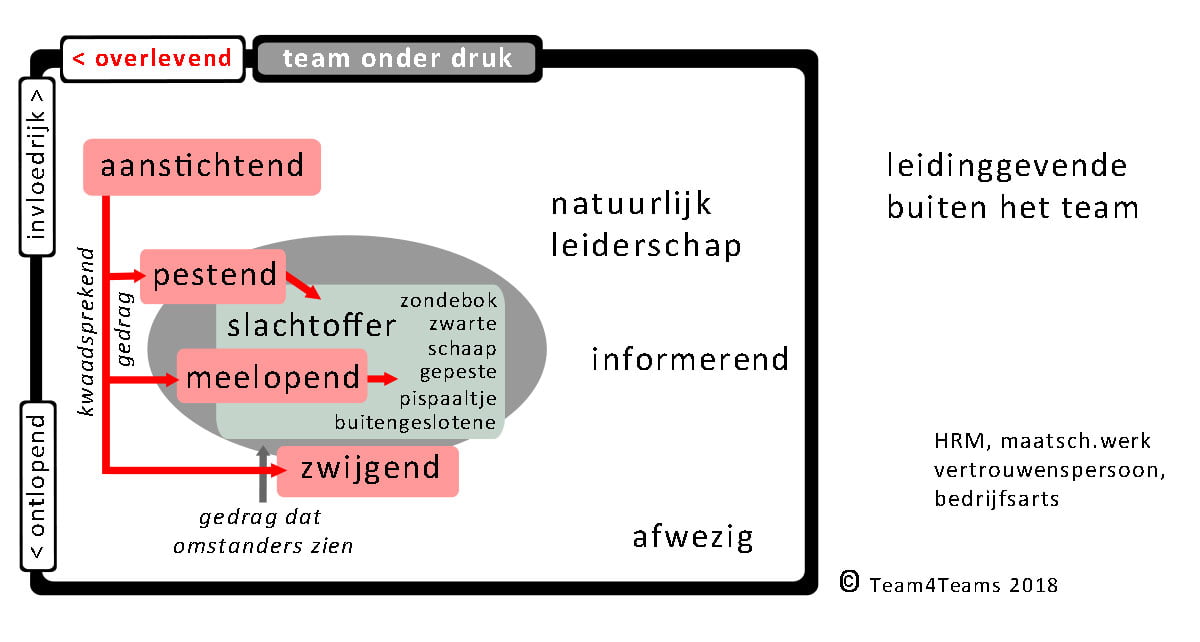
Is an informing team member a snitch or an informant? An informant deserves protection and support. In addition, the change process is exciting in the beginning. Anyone who wants change can only achieve it with colleagues inside and outside the team: HRM, a confidential advisor, social work, a company doctor, a supervisor.
Sometimes there is a fear culture, the flywheel spins in the wrong direction when there is fear. Those involved then easily fall back into old behaviour, employees feel they are rowing against the current. If the flywheel comes to a halt, that is already a huge victory, even though no one will experience it that way. Stagnation may give some peace, but not yet new energy. It is a matter of perseverance. No one can do this alone.
What happens when an employee satisfaction survey shows a negative picture? How much influence does a manager have? What about HRM? How do doctors and caregivers behave once bullying is reported? They too can become isolated and cannot cope alone.
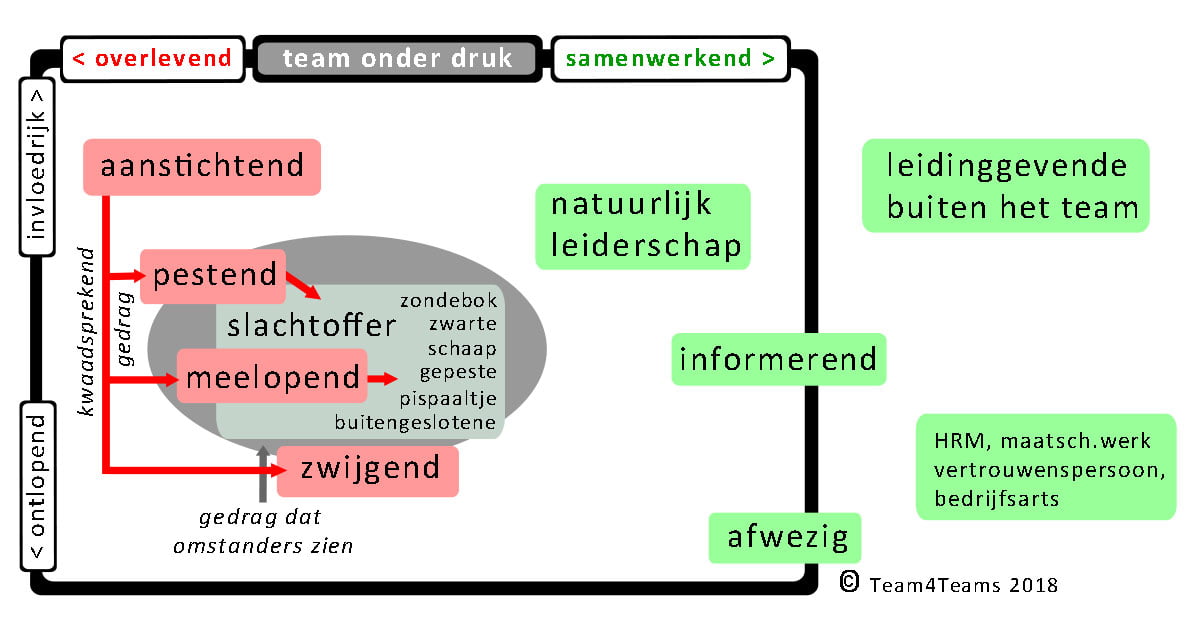
The Scale of Collaboration clearly shows what it takes to collaborate at a high level. You can see below the version we use in bullying groups. Teasing each other positively, playfully, mischievously and socially desirable is often a long way off. It is, however, the engine of every top team.
The role of an instigator, malcontent, schemer is often elusive. Yet the person filling this role needs to be seen, and asked to start contributing positively. Engage in conversation, ask for his or her help to become a collaborative group. Teach each other what helps in doing so. Stopping bullying is the right way forward, but it is not enough. Practising new positive behaviour and persevering is the message. Everyone has a role in this.
"When was the last time you expressed genuine appreciation?"

Well, what role do I actually have? Is there also a positive role to be filled by me?
One recognises 'natural leadership' in people who dare to stop undesirable behaviour. "That's enough now!" "Stop that!" "Can it be more positive? They show guts, can take a threshold and deploy their positive attitude.
They inspire a team. If the flywheel is spinning in the wrong direction, the role is missing or fails to come to fruition. Sometimes a person is alternately positive and angry and influential in both cases. Sometimes it is an influential subgroup.
We see the informant as the most positive role in a bullying group. However, this role is vulnerable and therefore deserves support.
Finally, there are the silencers. They stand by, allow the negative behaviour and sometimes laugh along. For a victim, the silent ones are regularly the worst group: "Everybody looked at it, they laughed at me, nobody did anything..."
Besides silencers, there are also team members who consistently walk away as soon as the atmosphere takes a negative direction. They feel powerless, do not want to be involved in the negative actions and thus walk away.
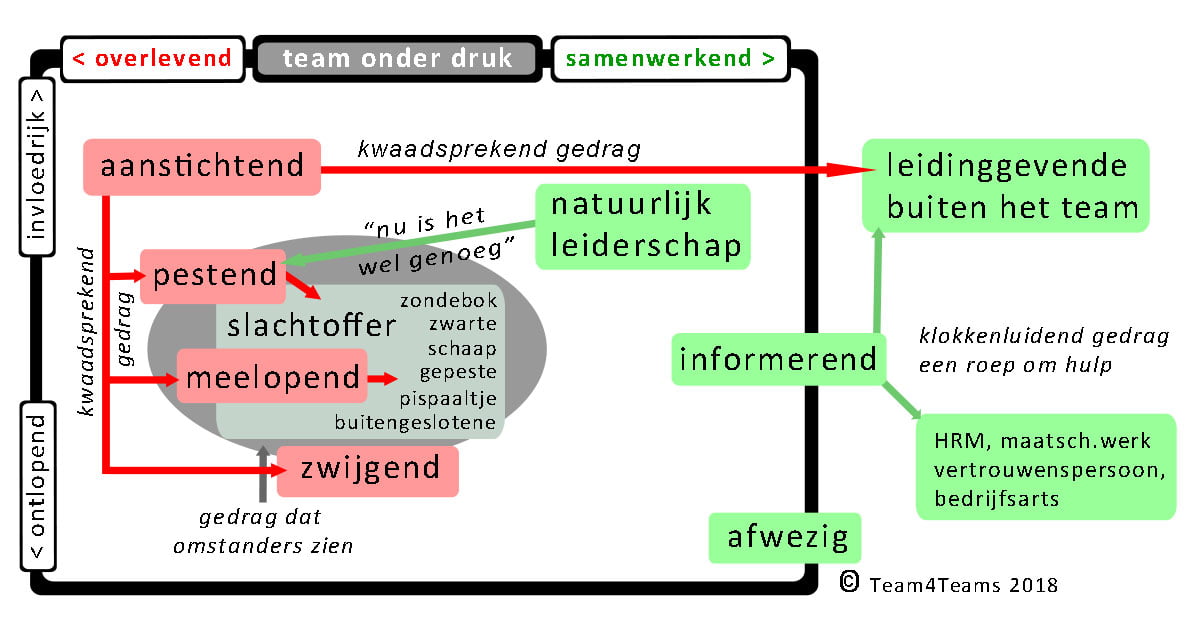
In the picture above, the manager is placed in a collaborative and influential position. This is an ideal situation. However, we see much more often that managers struggle to transform negative behaviour. In fact, they then find themselves with the silent or absent group. Sometimes the manager is involved in negative behaviour. Managers may feel powerless and be victims themselves.
Not only positive roles play a role in a transition. Once the undesirable behaviour in a team is brought to the table, there will also be confusing moments at first. The group denies, the pressure focuses on one group member, the bearer of the bad news. A blaming counterproductive atmosphere develops, influential team members disinform (malign). The victim also shows survivor behaviour and is unable to function properly. This negative behaviour is often not well understood by colleagues, social workers, HRM and a supervisor. "The victim himself makes it look like it" is a common comment.
People who inform see the bullying behaviour, but often do not acutely see its instigating source. Moreover, a bullying group is a tangle of mounting resistances, recriminations and accusations, where no one sees the root or cause, the original problem, anymore.
For a team coach, it does not make much sense to stir into 'what is going on'. Looking for underlying causes does matter. Where is the 'pin' causing the pain?
> Read more in the blog: coping with imbalance.
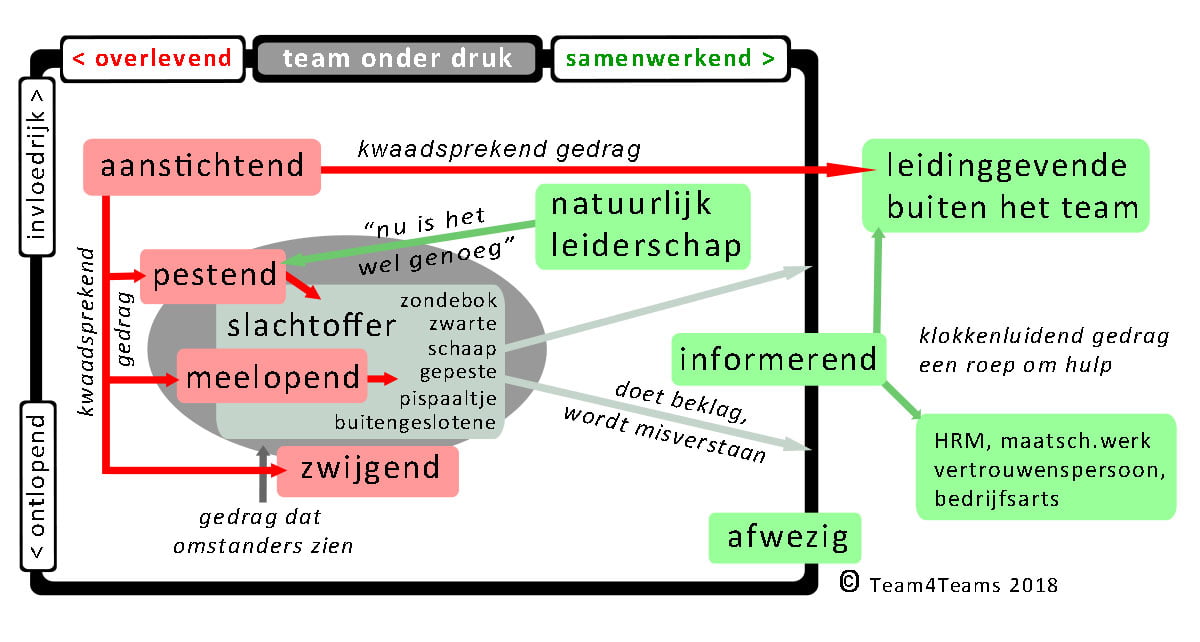
Even though it is complex, tackling bullying at work pays off. A professional approach delivers flexibility, creativity, willingness to change and job satisfaction. Employees feel like doing it again: 'I got my job satisfaction back!'
No group is the same, there is no one approach that works everywhere. A team coaching programme usually lasts six months. An intensive start is followed by short implementation sessions that decrease in intensity. Once team members alternately show natural leadership, the group can again do it by itself.
Only the team itself can do it. When starting up, help from outside the team is needed. Support from within the organisation is essential.