English (UK)
  Nederlands
Feedback or Feedforward
In our field, there is debate about the terminology surrounding feedforward and feedback.
Feedforward would be more forward-looking and thus more positive than feedback.
At Team4Teams, however, we continue to opt for feedback: looking back with a future goal in mind in order to better see ahead.
Being nurtured by experiences and learning from them: feed-back.
Feedforward, a nice play on words,
We get it and we'll leave it at that.
But we also use a contradiction.
But not 'feedforward' as something positive and 'feedback' as something negative!
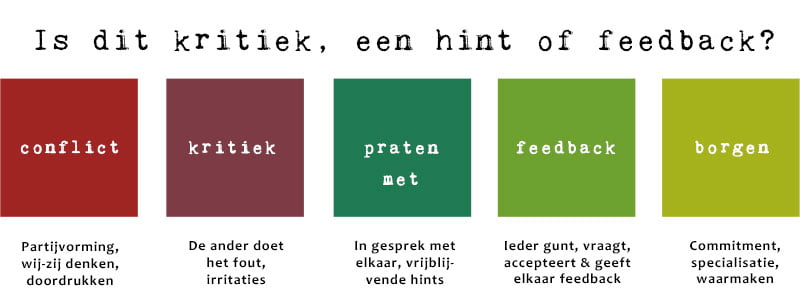
We use criticism next to feedback.
In an increasingly exciting world, more topical than ever before.
Criticism focuses on the person
At Criticism is 'looked back and judged'.
This happens - usually on impulse - from irritation, impatience, powerlessness or fear.
In a critical situation, people blame others for a mistake in order to stay out of harm's way themselves.
There will be on the person played. This provokes resistance and discussion, with the other person unable to avoid getting defensive. After all, those who don't defend themselves must be guilty. It is a negative process that costs a lot of energy and produces little learning. It makes cooperation unsafe and damages trust in each other.
In teams where criticism is heard regularly, there is a risk that this may lead to a culture of impatience, powerlessness and fear. Especially if the criticism comes from influential people.
Feedback focuses on the task
Feedback In contrast, it does not focus on who makes the mistake, but on a goal or task: where do you want to go together? Feedback has three steps, keeping an equal relationship with each other:
- Clearly stating to each other what everyone's goal is. Looking back and forward with this goal in mind - both, that is:
"This is my goal, what is going well, what could be better?" - Picking up the feedback: "What are you doing, what am I doing?"
- And returning to the feedback - this is the most important step: "Are you succeeding? What do you need to take the next step?" We call this 'safeguarding'.
Those who give feedback but do not return to it have not given feedback, but a hint. A hint is fine, but don't expect anything from it.
Difficulties and opportunities
There is another important reason why feedback has a positive connotation for us. Looking ahead without bringing the difficulties to the table leads to nothing. What hooks? What is still in the way? What is holding back a choice? What deficit is being experienced? These are essential questions. Looking ahead without wanting to look back and also see the problems behind the difficulties inhibits team development. One can only try out possibilities when the difficulties are visible and discussable on the table.
As a concept, therefore, feed-back is not so bad.
Starting a feedback process
A feedback process only starts when you tell each other a learning experience grants. Thinking to give feedback out of irritation or annoyance almost always leads to a situation where, because of the negative body language, the receiver receives the feedback as criticism. Consultation is then needed first to get what is in the way on the table.
A feedback process is successful when it energises all participants. Each in his or her position, everyone picks it up and gets appreciation when it is done. Jointness is created, with team members each supporting from their own position; we are not equal, but equal in terms of being approachable for the common goal.
Feedback or Feedforward?
Feedback thus.
Feedforward, nice pun, we get it and we'll leave it at that.
- Day training
- Practical and with tips on giving good feedback
- Includes a translation to the work situation
- For existing teams, in which the pressure is on
- Practical and with tips on giving good feedback
- Includes a translation to the work situation
- With repetition to properly secure